Article · FinCrime history
When Prestige Outran Controls
Riggs Bank built a diplomatic franchise on reputation, then lost its independence when AML controls failed the relationships that franchise invited.
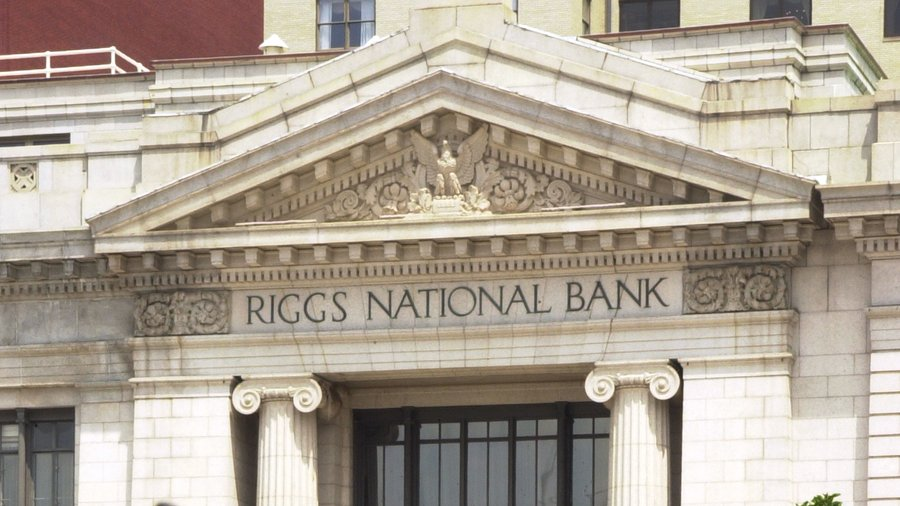
On 13 May 2005, PNC Financial Services completed its acquisition of Riggs National Corporation. Within days the Riggs name left the branches. The bank did not fail on bad loans or a liquidity run. It failed because a prestigious Washington franchise (embassy banking, foreign governments, politically exposed persons) was run without the customer due diligence, surveillance, escalation, and reporting those relationships required.[1][2]
Senate investigators later called the anti-money-laundering program almost completely dysfunctional. Regulators had warned for years. Civil penalties, a criminal guilty plea, Pinochet-related settlements, and a cut-price sale followed. The lesson for FinCrime desks is still blunt: relationship value and diplomatic status do not substitute for evidence-based control. They often create the pressure that overrides it.[2][5]
A franchise built on diplomatic access
By the early 2000s Riggs held roughly $6 billion in assets and about $4.29 billion in deposits. Its signature line was Embassy Banking. Staff told Senate investigators the bank served more than 95 percent of foreign missions and embassies in the Washington area, guided by a principle of opening accounts for any country or individual holding State Department diplomatic credentials. That franchise generated about 20 percent of the bank’s deposits. Forty-four percent of the embassy deposit base came from African and Caribbean nations; an OCC analysis found about 7 percent of embassy relationships involved jurisdictions designated as non-cooperative with international AML efforts.[2]
Many embassy accounts functioned like private banking for senior officials and relatives without being treated as such. Equatorial Guinea and Saudi Arabia were the two largest clients. The failure was not serving embassies or PEPs. It was that controls never matched the risk accepted.[2][3]
Pinochet: concealment as product
From 1994 through 2002, former Chilean leader Augusto Pinochet and his wife maintained accounts, investments, and certificates of deposit at Riggs in the United States and its London branch. The Department of Justice stated they deposited more than $10 million, and that Riggs did not conduct sufficient source-of-funds due diligence or report transactions it knew or had reason to know were suspicious.[5]
The Senate Permanent Subcommittee on Investigations described a more deliberate pattern of concealment. Bank leadership solicited the business while Pinochet faced a Spanish indictment for crimes against humanity and, later, a worldwide attachment order. Riggs helped form two Bahamian shell companies, Ashburton Company Ltd. and Althorp Investment Co. Ltd., with Riggs personnel listed as officers and directors so Pinochet’s name never appeared on incorporation papers. About $1.6 million moved from London to the United States in March 1999, two days after the British Law Lords authorized an extradition hearing. Personal U.S. account titles were changed from “Augusto Pinochet Ugarte & Lucia Hiriart de Pinochet” to “L. Hiriart &/or A. Ugarte,” so a search for “Pinochet” would return nothing.[2]
Cashier’s checks finished the concealment pattern. DOJ described five episodes from August 2000 to January 2003 in which $1.9 million was converted into $50,000 cashier’s checks and delivered in Chile. The Senate staff report put the total at more than $1.9 million, some checks drawn on the bank’s concentration account so they could not be traced to his accounts. A 1998 Ashburton profile listed the beneficial owner as “Kept in Vault,” a retired professional whose wealth was “public knowledge,” and disclosed none of the multi-country litigation against a former head of state.[2][5]
When the OCC requested PEP accounts in July 2000, Pinochet was left off. Examiners found the accounts in spring 2002 during a terrorist-financing review, after coded cashier’s-check-log entries. Riggs filed a SAR at the OCC’s direction; the OCC found it so deficient that it filed its own. The July 2004 Senate staff report initially identified at least nine Pinochet accounts with deposits up to $8 million. A March 2005 supplemental PSI report raised the count to 28 Riggs accounts spanning 25 years and traced at least 125 U.S. accounts across several institutions. Fragmented account views and aliases still hide the same pattern.[2][8]
Equatorial Guinea: a network treated as accounts
Equatorial Guinea showed the other failure mode: the bank’s largest client received no meaningful scrutiny. Senate staff found more than 60 accounts and CDs for the E.G. government, officials, and families from 1995 through 2004; by 2003 deposits ran $400-700 million, the bank’s largest relationship. DOJ, using a narrower frame, stated Riggs opened more than 30 accounts for the government, senior officials, and families between 1996 and 2004. Both figures stand as each source stated them. An AML program must assess the relationship network (government, PEP, family, and shared-control offshore vehicles), not each legal account in isolation.[2][5]
Senate staff documented nearly $13 million in cash deposits from 2000 to 2002 into accounts controlled by President Teodoro Obiang Nguema Mbasogo and his wife; two cash deposits totaling $3 million into Otong S.A., a Bahamian shell Riggs helped establish, with the Presidential Palace in Malabo as the address; and more than $35 million wired from the oil revenue account to two unknown companies in bank-secrecy jurisdictions. The accounts were not designated high-risk until October 2003. A 2002 internal credit analysis noted weak governance, opaque oil-sector management, and human-rights abuses; the bank lent anyway and kept taking cash.[2]
Prosecutors sharpened related numbers: more than $11 million into Otong in six cash transactions over two years with no plausible explanation, and 16 wires totaling about $26.4 million (June 2000-December 2003) from the oil royalty account to an entity in Spain. When Riggs asked two banks under PATRIOT Act §314 to identify recipient owners, both declined, citing secrecy laws at Luxembourg and Spain affiliates.[2][5]
Embassy officer Simon Kareri handled the E.G. accounts for years with little supervision, became sole signatory on a substantial E.G. account, and advised the government financially. FinCEN found he held signatory authority on two relationship accounts, altered a check on a PEP account, and moved more than $1 million from government accounts to a private investment company at another U.S. bank. The Senate identified that company as Jadini Holdings, controlled by his wife. Riggs fired him in January 2004. He invoked the Fifth before the subcommittee that July; he later pleaded guilty to 14 counts and received an 18-month sentence.[2][3][15]
Saudi cash, PUPID, and the 9/11 question
The Saudi embassy relationship first pulled regulators into sustained action. In 2000, Omar al-Bayoumi opened accounts for two of the September 11 hijackers; his wife later received payments from the wife of Ambassador Prince Bandar bin Sultan through a Riggs account. The FBI and the 9/11 Commission found the money was not intentionally routed to terrorists. Investigators still flagged the bank’s weak safeguards. The DOJ plea did not cover the Saudi accounts.[2][5][14]
FinCEN, describing the holder only as a foreign government, cited tens of millions in cash withdrawals over two years by the government, PEPs, and employees, most payable upon proper identification (PUPID), plus dozens of sequential international drafts and cashier’s checks payable to the holder and often returned for redeposit. None was reported as suspicious. Senate staff noted the OCC’s deep review followed November 2002 press reports linking Riggs accounts to the attacks.[2][3]
Four pillars down, and reports that did not help
FinCEN’s May 2004 assessment mapped Riggs’s failures to each required element of a Bank Secrecy Act program. As of January 2003, the bank was deficient in all four.[3]
Internal controls used generic risk matrices, so management could not see risk concentrations. Enhanced due diligence for embassy banking, PEPs, and international private banking was weak or absent. Subpoenas were not routed to investigations. Management twice claimed to have stopped PUPID transactions while they continued. Independent testing was late and ineffective and skipped money-laundering and SAR coverage. BSA officer oversight of high-risk customers, transactions, and geographies was minimal. Branch training missed AML risk on site visits and red flags for money services businesses.[3]
Downstream effects were measurable. From 2000 through 2003, Riggs failed to file or filed late about 33 SARs covering at least $98 million; later review found another 61 SARs more than 60 days late. Structuring SARs used sparse narratives that omitted type, timing, and amount, omissions FinCEN said made pursuit harder for law enforcement. Six CTRs described a PEP-owned private investment company as a timber exporter, masking $11.5 million in cash over two years. FinCEN deemed the violations willful (reckless disregard), citing failure to comply with the OCC’s July 2003 consent order.[3]
Warnings without correction
Examiners had flagged major AML deficiencies since at least 1997, but senior OCC personnel let them persist. The agency later told Senate investigators, “We gave the bank too much time.” Earlier exams still rated the program “satisfactory” or “generally adequate.” After anti-terrorist-financing reviews and a 2003 examination, the OCC issued a cease-and-desist order; a return exam then found new Equatorial Guinea problems.[2][6]
The Senate focused on the Examiner-in-Charge. In 2001 he opposed formal enforcement because Riggs had promised fixes. In July 2002 he told examiners not to place the Pinochet memo or workpapers in OCC electronic files, which Senate staff called highly unusual. About a month later he joined Riggs; over the next 18 months he attended OCC meetings on Riggs AML problems without ethics-office clearance. R. Ashley Lee rose to EVP and chief risk officer and was placed on paid leave in 2004 pending a DOJ ethics review. Senate staff recommended a one-year cooling-off period before an EIC could join a supervised bank. OCC deputy chief counsel Daniel Stipano said publicly: “What happened with Riggs is unacceptable. It cannot be repeated.”[2][13]
Civil, criminal, and commercial consequences
On 16 July 2003, the OCC entered a comprehensive consent order requiring Riggs to overhaul its BSA program and referred the violations to FinCEN. On 13 May 2004, FinCEN and the OCC assessed concurrent $25 million civil money penalties, satisfied by one payment, then the largest BSA civil penalty against a U.S. financial institution. FinCEN Director William Fox cited “systemic failure to comply with its obligations under the Bank Secrecy Act.” The OCC’s separate order required governance reforms: management-competence assessment, written Embassy and International Private Banking controls, background checks for relationship managers, a ban on employee signature or custodial powers over customer accounts, and an audit program able to detect irregularities. The Federal Reserve issued a cease-and-desist order against the holding company the same month.[3][4][7][2]
On 15 July 2004 the PSI held its hearing, with Riggs President and CEO Lawrence Hebert among the witnesses.[16] On 27 January 2005, Riggs pleaded guilty to a one-count information charging failure to file timely and accurate SARs under 31 U.S.C. §§ 5318(g) and 5322. It agreed to a $16 million criminal fine and five years of corporate probation. U.S. Attorney Kenneth Wainstein called the conduct “more than simply blind neglect.” The bank closed Embassy Banking and International Private Banking. Combined civil and criminal federal penalties reached $41 million.[5][11]
In February 2005, Riggs and the Allbritton family, the bank’s controlling shareholders, agreed to pay $9 million to victims of the Pinochet regime, and the bank paid $8 million to settle the related Spanish case, about $17 million in Pinochet-related settlements on top of the federal penalties.[12]
The deal that priced the failure
The fines were survivable; the franchise damage was not. PNC had agreed in July 2004 to buy Riggs for about $779 million ($24.25 per share). After the guilty plea, PNC sought a lower price and added closing conditions on litigation reserves and deposit floors. Riggs’s board rejected the proposal and sued; three days later the parties settled at $20 per share, roughly $652 million, about 16 percent and $127 million below the original deal. The merger closed on 13 May 2005; shareholders received about $297 million in cash and 6.6 million PNC shares. PNC soon exited embassy banking entirely.[1][9][10]
What investigators still pull from the file
The red flags were textbook: sequential round-dollar cashier’s checks and drafts payable to the holder; large recurring PEP cash with no documented source; bank-formed shells with nominee officers; account titles altered after adverse attention; sovereign-revenue wires to unknown secrecy-jurisdiction entities; a relationship manager with signing authority and personal financial ties to the client. Each should have produced an alert, an investigation, and a timely SAR with a complete narrative.[2][3]
For desk practice, five moves still follow. Treat relationship concentration as a risk amplifier: prestige embassy or PEP books need specialist staffing, board visibility, and testing independent of revenue owners. Manage connected parties as one risk universe. Make enhanced due diligence event-driven as well as periodic when subpoenas, adverse media, foreign legal process, material cash, or anomalous instruments appear. Protect investigative independence: forbid or tightly control employee authority over customer accounts, and require second-line review of high-risk alert closures. Write SARs for an investigator: who did what, when, where funds moved, why the pattern is suspicious, what evidence supports that finding, and what the institution did next.[2][3][4]
Ask for the relationship map, not only a target account: linked entities, opening packets, KYC/EDD refreshes, alert histories, SAR decision records, instrument images, wire details, employee authority records, and communications around known risk events. The revealing evidence is often the gap between what the institution knew, or should have known, and what it documented, investigated, and reported.
For most of its 169 years Riggs traded on prestige. The record that remains is narrower. When commercial relationships outrank risk discipline, the cost can be the institution itself.[1][2]
Sources
- PNC, “Completes Acquisition of Riggs National Corporation” (May 13, 2005)
- Senate PSI Minority Staff, Money Laundering and Foreign Corruption… Case Study Involving Riggs Bank (July 14, 2004)
- FinCEN, Assessment of Civil Money Penalty: Riggs Bank, N.A., No. 2004-01 (May 13, 2004)
- OCC, “Assesses $25 Million Penalty Against Riggs Bank N.A.” (May 13, 2004)
- DOJ / USAO-DC, “Riggs Bank Enters Guilty Plea and Will Pay $16 Million Fine” (January 27, 2005)
- OCC, “Comptroller Hawke Directs Review… BSA Compliance at Riggs Bank” (June 3, 2004)
- FinCEN, “Assesses $25 Million Civil Money Penalty Against Riggs Bank N.A.” (May 13, 2004)
- Senate PSI, Supplemental Staff Report on U.S. Accounts Used by Augusto Pinochet, S. Prt. 109-25 (March 16, 2005)
- PNC / Riggs, “Revised Merger Agreement,” Form 8-K Ex. 99.1 (February 10, 2005)
- AP / NBC News, “Riggs agrees to reduced PNC takeover bid” (February 10, 2005)
- Terence O’Hara, “Riggs Bank Agrees to Guilty Plea and Fine,” Washington Post (January 28, 2005)
- BBC News, “Bank payout to Pinochet victims” (February 26, 2005)
- Kathleen Day & Terence O’Hara, “Riggs Bank Suspends 2nd Senior Executive,” Washington Post (September 11, 2004)
- AP / Rutland Herald, “Riggs Bank pleads guilty…” (plea did not cover Saudi accounts)
- Human Rights Watch, Well Oiled (Kareri plea / sentence) (July 9, 2009)
- Senate PSI hearing page, “Money Laundering and Foreign Corruption…” (July 15, 2004)