Article · FinCrime history
The Bank That Was Built to Hide
BCCI, the “Bank of Crooks and Criminals,” and the fall of a global financial-crime platform
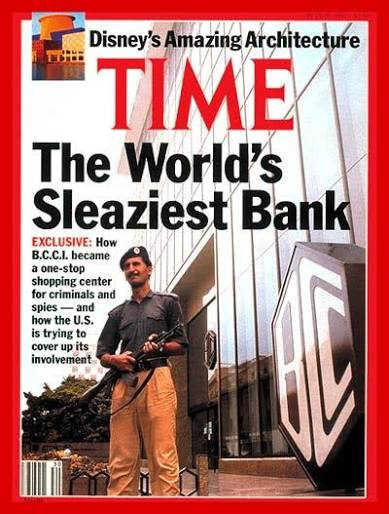
On 5 July 1991, regulators in multiple countries moved together against the Bank of Credit and Commerce International. In Britain, the Bank of England shut BCCI’s branches and froze deposits; staff and customers learned the scale of the intervention only as it landed. BCCI was not a healthy bank that suffered a sudden run. It was an institution whose corporate design (fractured across secrecy jurisdictions, nominee shareholders, and auditors who never saw the whole book) had long served as infrastructure for fraud and money laundering on a multinational scale.[1][2]
U.S. investigators and intelligence officers already had a working nickname for it. Former Customs Commissioner William von Raab later told Congress that Robert Gates, then a senior CIA official, had referred to BCCI as the “Bank of Crooks and Criminals.” The name stuck because the paper trail later backed it up.[3][4]
A bank designed without a center
Agha Hasan Abedi founded BCCI in 1972 and marketed it as a multinational bank for the developing world. The legal map told a different story. The group layered Luxembourg and Cayman entities, ran major operations from London, and multiplied affiliates until no single supervisor could claim consolidated sight of the whole. Senators John Kerry and Hank Brown, in their December 1992 report to the Senate Foreign Relations Committee, described a “corporate spider-web” with Abedi and his deputy Swaleh Naqvi at the center, built to frustrate government control as a matter of routine.[1]
That structure was the product. Shell companies, secrecy havens, front men, buy-back deals, and back-to-back documentation let BCCI move capital and conceal losses while projecting the image of a well-capitalized Third World champion. By the time of the global closure, BCCI operated across roughly seventy countries. The same architecture that powered growth also made honest supervision nearly impossible.[1][5]
What the criminal menu looked like
The Kerry-Brown executive summary is blunt. BCCI’s criminality included fraud measured in billions; money laundering across Europe, Africa, Asia, and the Americas; bribery of officials; support for terrorism and arms trafficking; facilitation of tax evasion and smuggling; and illicit purchases of banks and real estate. The tools were familiar to any modern typology desk: nominees, layering, kickbacks, intimidation, and well-placed intermediaries who discouraged official action.[1]
Drug money was not a side story. In the late 1980s, U.S. Customs’ Operation C-Chase, an undercover money-laundering investigation led in the field by agent Robert Mazur, pulled BCCI bankers into a sting that produced a 1988 Tampa indictment. In January 1990, BCCI entered a plea agreement that included a multimillion-dollar fine (contemporary reporting put related penalties near $14-15 million). Kerry criticized the deal for letting the institution avoid a fuller airing of its broader crimes and for leaving the bank alive.[1][6]
Customers and relationships made the platform valuable to the powerful. BCCI’s services touched figures such as Panama’s Manuel Noriega; the bank’s U.S. strategy relied on prestigious lawyers and political access. Clark Clifford, the former Defense Secretary, and Robert Altman became central faces in BCCI’s American story, later accused by prosecutors and the Federal Reserve of knowing, or needing to know, that BCCI secretly controlled First American Bankshares through nominee arrangements. Whether every Washington actor was deceived or complicit remains contested in the record; the regulatory failure is not.[1][7]
How BCCI entered the United States
U.S. banking rules were supposed to keep an opaque foreign group from quietly owning American institutions. BCCI treated that barrier as a design problem. Through CCAH and related vehicles, it pursued control of Financial General Bankshares (later First American) using nominees and assurances that BCCI was only an adviser, not the owner. The Federal Reserve approved transactions in part because lawyers and shareholders represented that BCCI was not financing or directing the takeover. Those representations were false. Kerry’s report concludes BCCI succeeded in acquiring U.S. banking interests spanning multiple states and the District of Columbia despite regulatory suspicion.[1]
The pattern (front men, prestige counsel, fragmented oversight) still reads as a working template for nested ownership and beneficial-ownership evasion. Investigators who map shell chains today are working the same problem BCCI industrialised.
The July collapse
By spring 1991, Price Waterhouse’s work for UK supervisors had exposed a massive hole: poor records, reckless lending, and fraud large enough that “true and fair” certifications could no longer paper over reality. The Bank of England had known for years that BCCI was hard to supervise. Lord Justice Bingham’s later inquiry criticised the Bank for relying too long on Luxembourg and for delaying a regime equal to the risk. Governor Robin Leigh-Pemberton told the public the Bank lacked clear Banking Act grounds until earlier that year.[2][5][8]
Manhattan District Attorney Robert Morgenthau’s investigation changed the endgame. Kerry’s report credits Morgenthau with breaking the wider case and with making a quiet Abu Dhabi-backed restructuring politically and practically untenable: an indictment in New York would have triggered a global run. On 5 July 1991, the Bank of England and counterparts elsewhere closed BCCI. About 120,000 UK customers saw branches shut and deposits frozen; liquidators later described a multi-billion-pound deficit. Contemporary accounts called it the largest financial fraud then on record.[1][2]
Later that month, Morgenthau’s office indicted BCCI, Abedi, and Naqvi on charges including fraud, falsifying records, and larceny, described by Morgenthau as the largest bank fraud in world financial history. The Federal Reserve sought a record civil penalty measured in the hundreds of millions of dollars and moved to bar key figures from U.S. banking.[9]
What investigators still take from BCCI
BCCI’s fall did not invent financial crime. It showed how a bank can be purpose-built as a crime platform when incorporation, audit, and political access are weaponised together. The points that still matter on a FinCrime desk:
- Consolidated supervision is not a slogan. If no regulator sees the whole group, crime hides in the seams.
- Nominee ownership and “advisory only” stories are red flags until proven otherwise, especially when prestige names are attached.
- Plea deals that treat a systemic laundromat as a single Tampa branch case can buy time for the institution, not justice for the pattern.
- Auditors who certify “true and fair” while knowing the books are unmanageable become part of the concealment machinery.
- Intelligence use of a corrupt bank, even for otherwise authorised purposes, can blunt the will to shut it down.
Kerry and Brown closed their report with legislative recommendations: harder pressure on secrecy havens, better interagency cooperation, upgraded tracking of foreign financial institutions, and tighter accountability for foreign auditors whose certifications are used in the United States. Those recommendations read less like 1992 history than like an unfinished checklist.[1]
BCCI called itself a bank for the Third World. The record shows a different mission: a border-hopping trust service for people who needed money moved without a reliable paper trail. When regulators finally closed the doors in July 1991, the surprise was not that crime had occurred. It was how long a structure built for invisibility had been allowed to operate in plain sight.
Sources
- Kerry & Brown, The BCCI Affair: Executive Summary (FAS) · Full index · PDF
- BBC On This Day: 5 July 1991 bank closure
- Newsweek: The CIA and BCCI (Gates nickname)
- Kerry-Brown Ch. 11: CIA and foreign intelligence
- Sikka / BCCI supervisory narrative (cites Bingham)
- Kerry-Brown Ch. 8: Justice, Customs, C-Chase
- Wikipedia: BCCI overview (locator)
- Bingham inquiry summary
- LA Times: Indictments & Fed fine (30 July 1991)
- Public Intelligence: BCCI Affair landing
- NYT Books: Bank of Crooks and Criminals International