

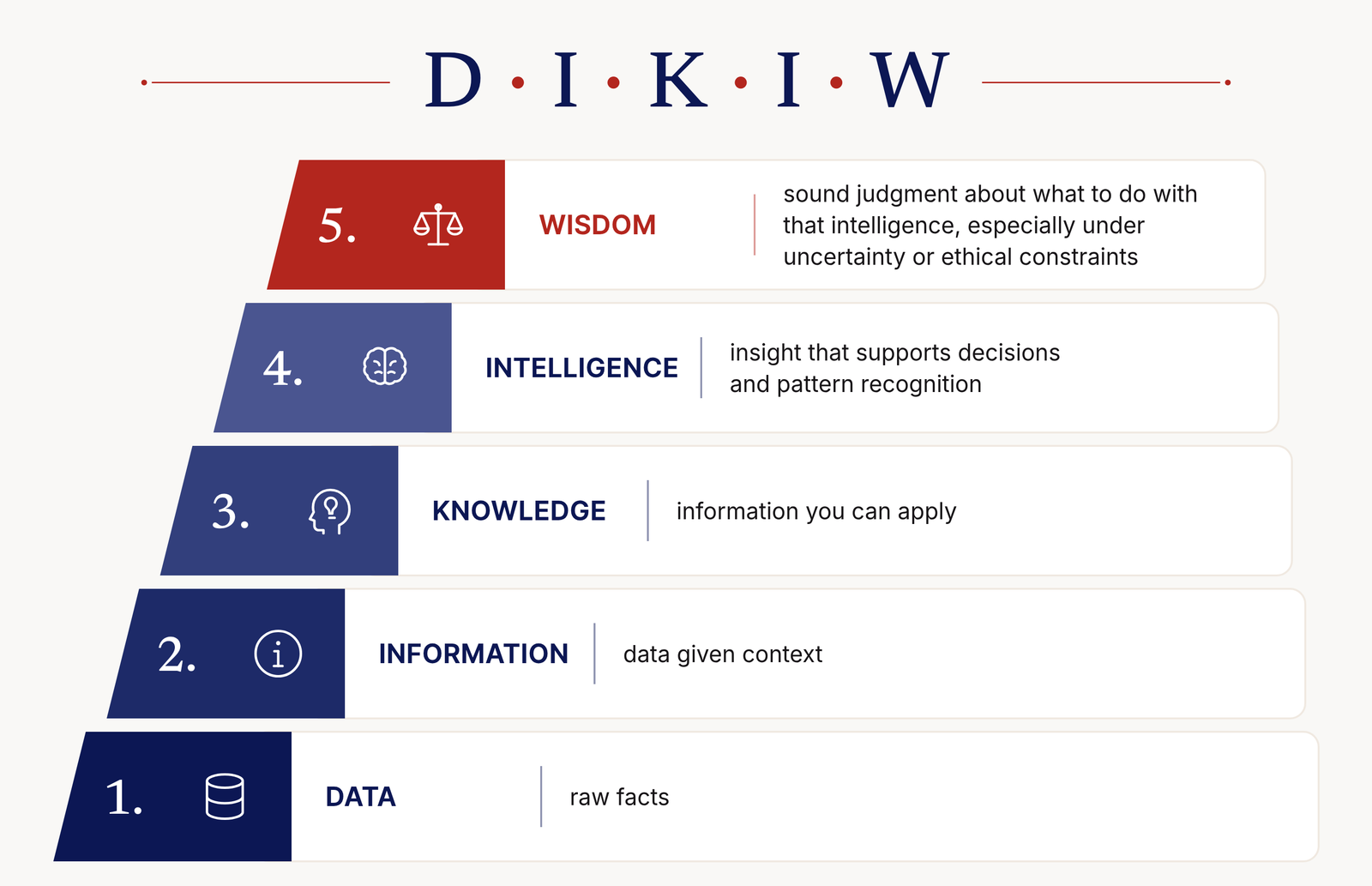
Five steps, from a record to a decision
The ladder reads from the bottom up. Each step is built from the one beneath it.
- 1Dataraw facts
- 2Informationdata given context
- 3Knowledgeinformation you can apply
- 4Intelligenceinsight that supports decisions and pattern recognition
- 5Wisdomsound judgment about what to do with that intelligence, especially under uncertainty or ethical constraints
Skip a step and the work shows it. Judgment without data is opinion. Data with nothing built on top of it is a pile of records nobody has read.
The ladder inside a financial crime case
Data
A bank's records start as data: cash deposits, wire messages, account opening forms, a company's registered address. A single $9,500 deposit is a number and nothing more.
Information
Line that deposit up beside the same customer's other deposits that week, each one just under the $10,000 threshold for a currency transaction report, and the numbers now have context.
Knowledge
Knowing what the context means is knowledge. Breaking up cash to avoid that report is its own federal offense, structuring, under 31 U.S.C. 5324. Typologies, red flags, and the methods laid out in the case files work the same way: lessons an analyst can apply to the next account.
Intelligence
Intelligence starts when patterns across accounts support a decision. The structured cash leads to a money services business, the business sends wires through a correspondent account, and the counterparty shows up in a typology the analyst has seen before. The suspicious activity report, which the FinCEN guide calls the BSA's most valuable output for law enforcement, is where that picture gets written down.
Wisdom
Wisdom decides what to do with the picture, usually before it is complete. File now or keep watching. Exit the customer or hold the relationship. Escalate a profitable client to people who would rather not hear about it. Institutions make these calls at scale, too. TD Bank chose not to automatically monitor domestic ACH transactions, and 92 percent of its transaction volume went unmonitored from 2018 to 2024; the bank pleaded guilty. The enforcement section covers what follows when that judgment fails.
Where the model comes from
The classic version has four steps (data, information, knowledge, wisdom) and is usually written DIKW. It is widely traced to Russell Ackoff's "From Data to Wisdom", a presidential address from June 1988 published in the Journal of Applied Systems Analysis in 1989. Ackoff's own ladder had an extra rung, understanding, which he tied to answers to "why" questions. He also wrote that "Intelligence is the ability to increase efficiency; wisdom is the ability to increase effectiveness."
Jennifer Rowley's 2007 review in the Journal of Information Science, "The wisdom hierarchy", called the hierarchy one of the "taken-for-granted" models in the information and knowledge literatures and began by revisiting "Ackoff's original articulation." Reading the textbooks, she found less agreement on how one step turns into the next than on the steps themselves, and "limited reference to wisdom."
The five-step version has a name of its own. In a 2013 paper in Business Management Dynamics, Anthony Liew argued that "the missing 'Intelligence' in DIKW plays a major role between knowledge and wisdom" and called the revised model DIKIW. The one-line definitions on this page are Investigatable's own, written for financial crime work.
Why it sits under the name
The sections of this site follow the same climb. The timeline and its bibliographies supply the data and information: what happened, when, at what scale, with a source for each row. Laws & Regulations and The Banking & Financial System are knowledge you can apply. The FinCrime Ecosystem and the case files work at the intelligence step, connecting methods, networks, and failures across cases. Enforcement records what happened when judgment ran out.
Wisdom is the step no website can supply. It belongs to whoever is at the desk, deciding what to do with what they now know. The tagline is there as a reminder that the climb is the job.